Start with the learning question
In a large class, twenty students may ask essentially the same question in different languages while a time-sensitive misconception spreads. Sorting chronologically alone obscures classroom demand.
In a large class, twenty students may ask essentially the same question in different languages while a time-sensitive misconception spreads. Sorting chronologically alone obscures classroom demand.
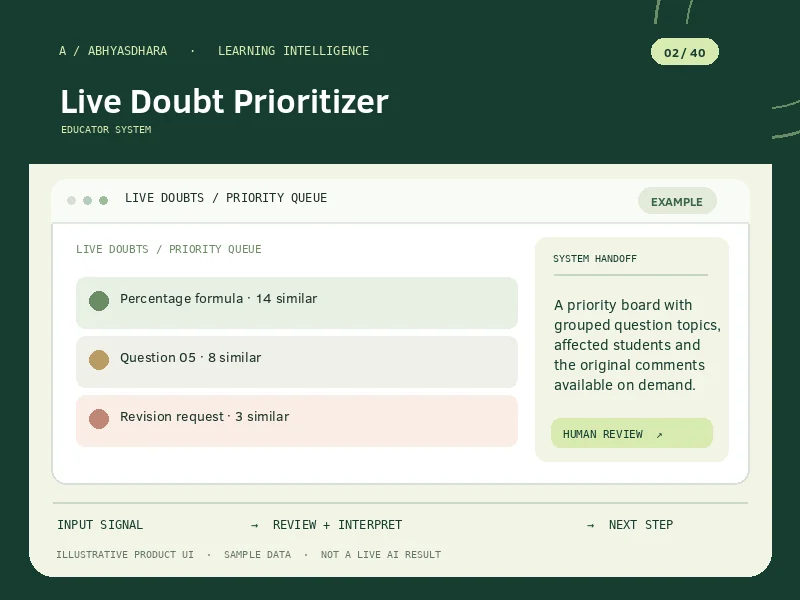
Groups similar live questions and brings repeated or urgent doubts to the top of the teaching queue.
Group semantically related doubts, count repeated themes and rank them by relevance, repetition and whether clarification is needed now.
Explore all 40 feature visuals →In a large class, twenty students may ask essentially the same question in different languages while a time-sensitive misconception spreads. Sorting chronologically alone obscures classroom demand.
Group semantically related doubts, count repeated themes and rank them by relevance, repetition and whether clarification is needed now.
A priority board with grouped question topics, affected students and the original comments available on demand.
Review the sequence from input to reviewable output.
In a large class, twenty students may ask essentially the same question in different languages while a time-sensitive misconception spreads. Sorting chronologically alone obscures classroom demand.
Questions that have already been identified from the lecture stream, lesson sections and time stamps.
Group semantically related doubts, count repeated themes and rank them by relevance, repetition and whether clarification is needed now.
A priority board with grouped question topics, affected students and the original comments available on demand.
Example only. This is not live customer data or an AI-generated result.
Eight students ask about why percentage change uses the original amount. The teacher sees one grouped concern and representative original messages.
Frequency is not the same as importance; a rare accessibility-related question or a complex doubt may still require immediate teacher attention.
Frequency is not the same as importance; a rare accessibility-related question or a complex doubt may still require immediate teacher attention.
Illustrations are not live AI output or evidence of tested accuracy.